UNIVERSITY WORKFLOW SOLUTION
Standardize invention communication across teaching, research, and technology transfer
IP DaVinci is a structured invention communication workflow system that helps universities improve disclosure clarity, reduce redraw dependency, maintain editable workflow continuity, and standardize invention communication across academic and innovation environments.
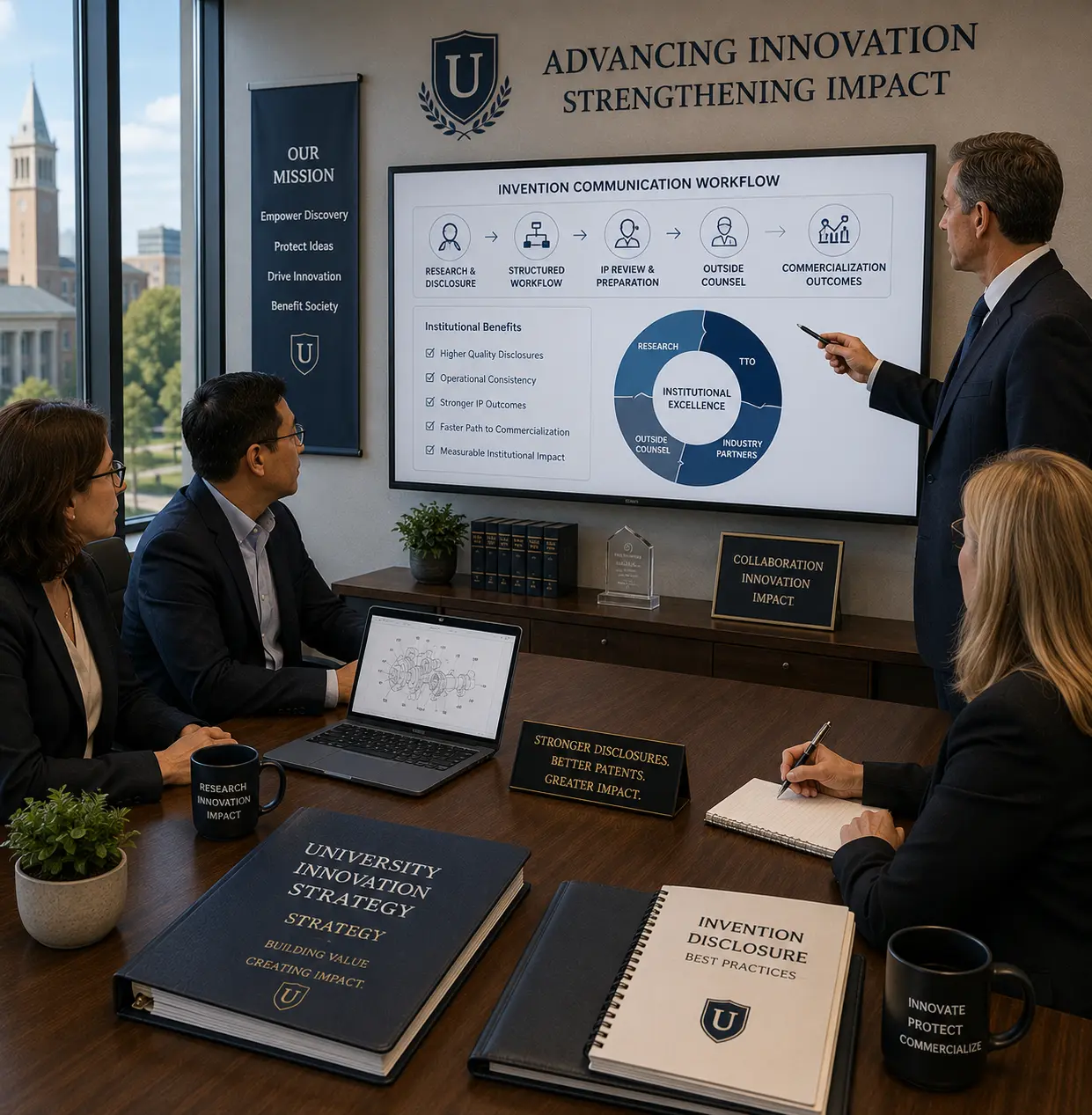
ACADEMIC WORKFLOW ENVIRONMENTS
Designed for real academic and innovation workflows
Structured invention communication workflows adapted for teaching, research, disclosure, and commercialization environments.
In many universities, invention communication begins as: slides, screenshots, disconnected technical visuals, informal diagrams, and fragmented research communication.
This creates operational friction across:
- coursework
- research collaboration
- invention disclosures
- technology transfer
- commercialization workflows
IP DaVinci introduces structured editable workflows designed to improve communication clarity, revision continuity, and institutional consistency across academic innovation environments.
No drafting background required
Designed for students, researchers, faculty, and TTO teams
Supports structured invention communication workflows
Maintains editable continuity across revisions and disclosures
Supports teaching, research, disclosure, and commercialization workflows
Works with existing Microsoft Visio licensing or Cloud Workspace
No CAD expertise or artistic drafting skill required
WORKFLOW BY ACADEMIC ENVIRONMENT
One workflow system adapted across university environments
Different institutional responsibilities. Shared workflow continuity.
Teaching & Coursework
Teach structured technical communication workflows that improve systems thinking, revision handling, and invention communication clarity.
- Structured communication workflows
- Revision-ready student projects
- Simplified feedback cycles
- Transferable professional skills
Research & Labs
Create structured editable invention communication workflows supporting collaboration, disclosures, and prosecution preparation.
- Cleaner invention communication
- Editable revision continuity
- Reduced redraw dependency
- Improved collaboration
Technology Transfer Offices
Standardize invention communication workflows across departments, disclosures, and outside counsel collaboration.
- Faster disclosure evaluation
- Reduced clarification cycles
- Cleaner counsel handoff
- Institutional workflow consistency
Institutional Leadership
Establish scalable invention communication standards across programs, research groups, and innovation initiatives.
- Operational consistency
- Scalable adoption
- Reduced workflow fragmentation
- Institutional continuity
Where Universities Use the Workflow System
One structured workflow system — multiple academic and innovation contexts.
Teaching & Coursework
Used in engineering, computer science, design, entrepreneurship, and IP-adjacent programs to teach structured technical communication workflows students can apply consistently.
Research & Invention Disclosure
Researchers and graduate students create cleaner, editable invention communication workflows for disclosures, collaboration, and patent preparation.
Technology Transfer & IP Offices
Standardize invention communication across departments, improve disclosure review, and streamline collaboration with outside counsel.
Cross-Department Collaboration
Shared workflow conventions improve continuity between research labs, instructional programs, TTO operations, and prosecution environments.
Educational Innovation Programs
Support capstones, incubators, innovation centers, and entrepreneurship programs using structured invention communication workflows.
What Universities Operationally Gain
Better invention communication. Cleaner revisions. Stronger institutional continuity.
Improved Disclosure Quality
Structured workflows improve invention communication clarity across research and commercialization workflows.
- ✔ Clearer embodiment communication
- ✔ Reduced disclosure ambiguity
- ✔ Improved review readiness
Faster Revision Handling
Editable workflows reduce redraw-heavy revision cycles as disclosures and inventions evolve.
- ✔ Same-file revisions
- ✔ Reduced recreation work
- ✔ Improved continuity
Institutional Standardization
Shared workflow conventions improve consistency across programs, departments, and research groups.
- ✔ Reusable workflow structures
- ✔ Comparable communication standards
- ✔ Cross-department continuity
Commercialization Readiness
Structured editable invention communication improves collaboration with outside counsel and commercialization stakeholders.
- ✔ Cleaner counsel handoff
- ✔ Reduced interpretation overhead
- ✔ Improved operational readiness
See how structured invention workflows operate in practice
A practical walkthrough demonstrating how invention communication moves through: teaching, research, disclosure intake, revisions, technology transfer, and commercialization workflows.
- Real editable invention communication workflows
- How universities reduce clarification loops
- How disclosure revisions are handled
- How same-file continuity improves commercialization readiness
- How workflows scale institutionally
Reusable workflows significantly reduce revision overhead
Structured editable workflows help universities handle repetitive invention communication tasks far more efficiently.
The same workflow methodology supports: invention disclosures, annotations, revisions, technical communication, commercialization workflows, and long-term editable continuity.
Reusable workflow structures reduce repetitive recreation work while improving institutional consistency and operational clarity.
A workflow system adapted for academic environments
Starter Package
Maintenance & Operational Support
Cloud Workspace
Studio Support
Deployment and access designed for academic environments
- Supports existing Microsoft Visio licensing
- Cloud Workspace available for Mac, Linux, and restricted-device environments
- No software installation required when using Cloud Workspace
- Compatible with labs, shared machines, and remote learning
- Supports phased pilot rollout before broader institutional deployment
- Academic pricing and pilot structures available
- Supports both instructional and operational workflows
How Universities Typically Adopt the Workflow
Pilot
Begin with one course, lab, research group, or TTO workflow to evaluate operational fit.
Department Adoption
Standardize workflow conventions across courses, research groups, labs, and disclosure environments.
Institutional Expansion
Extend workflow continuity across teaching, research, disclosure, and commercialization workflows.
Join the Friday Workflow Lab
Weekly operational sessions covering: invention communication workflows, disclosure revisions, redraw reduction strategies, commercialization readiness, and practical workflow standardization.
- • Live Friday workflow sessions (1 PM Eastern)
- • Session reminders and join links
- • Replay access after sessions
- • Upcoming workflow topics and updates
Used in Academic and Innovation Environments
“Students adopted the workflow quickly because the system removed software and formatting friction. ”
— Professor, Engineering Program
“Cloud Workspace solved our mixed-device deployment issues immediately. ”
— Program Director, University Research Lab
“Standardized invention communication dramatically improved disclosure review and collaboration with outside counsel. ”
— Technology Transfer Officer
Considering university or research deployment?
We’ll help you evaluate operational fit, access options, and a pilot structure aligned with your academic environment.